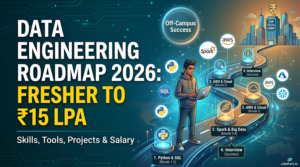
The landscape of software engineering is shifting. In 2026, while many roles are being automated by AI, the person who builds the data pipelines that feed those AI models is more valuable than ever. At JobsForU.in, we have seen a 40% increase in “Data Engineer” and “ETL Developer” job postings compared to last year.
If you are a fresher or an engineering student, this guide will walk you through the exact technical stack, project ideas, and interview strategies required to land a high-paying role in this field.
Why Data Engineering is the “Gold Mine” of 2026
Data is the new oil, but raw data is useless. Data Engineers are the “refiners” who take messy, unstructured data and turn it into clean, usable information for businesses. Unlike Web Development, which is highly saturated, Data Engineering requires a niche skill set that companies are willing to pay a premium for.
Market Comparison: Data Engineering vs. Other Roles
| Role | Learning Curve | Market Demand | Avg. Fresher Salary |
|---|---|---|---|
| Frontend Developer | Moderate | Very High (Competitive) | ₹4 – ₹7 LPA |
| Data Engineer | High | High (Undersupplied) | ₹8 – ₹14 LPA |
| Data Scientist | Very High | Moderate | ₹7 – ₹12 LPA |
Experience-Wise Career Growth & Salary Progression
One of the best things about Data Engineering is the exponential salary growth. Because the technical barrier to entry is high, your value increases significantly with every year of experience.
| Experience Level | Typical Job Title | Salary Range (India) | Core Responsibility |
|---|---|---|---|
| 0 – 2 Years | Associate Data Engineer | ₹6 LPA – ₹12 LPA | Writing SQL queries, basic ETL scripts. |
| 2 – 5 Years | Data Engineer II / Senior | ₹15 LPA – ₹30 LPA | Designing Cloud Pipelines, Spark optimization. |
| 5 – 8 Years | Lead Data Engineer | ₹35 LPA – ₹55 LPA | Architecting entire data ecosystems. |
| 8+ Years | Principal Engineer / Architect | ₹60 LPA+ / Stock Options | Strategy, Cost Optimization, Team Leadership. |
Step-by-Step Technical Roadmap
1. Mastering Data Manipulation (Month 1)
You cannot build a house without a foundation. For a Data Engineer, that foundation is Python and SQL.
- Must-Know SQL: You must go beyond
SELECT *. Focus on Window functions (Row_Number, Rank, Lead/Lag), Recursive CTEs, and understanding Query Execution Plans. - Python for Automation: Focus on
Pandasfor small-scale data cleaning andBoto3for interacting with AWS services.
2. The Big Data Ecosystem & Distributed Computing (Month 2-3)
Traditional databases like MySQL fail when you reach “Petabyte” scale. In this phase, you learn how to handle data that doesn’t fit on one computer.
- Apache Spark (PySpark): This is the most critical skill. Understand how “Lazy Evaluation” works and how Spark distributes tasks across a cluster.
- Kafka & Real-time Streaming: In 2026, companies want data now, not tomorrow. Learn how to process live streams of data.
3. Modern Cloud Warehousing (Month 4-5)
Cloud is where the jobs are. Most companies we list on JobsForU.in require either AWS or Azure knowledge.
- Snowflake: Learn about its unique multi-cluster shared data architecture.
- Databricks: Understand the “Lakehouse” concept, which combines the best of Data Lakes and Data Warehouses.
Top 3 Certifications to Boost Your Resume in 2026
Certifications help freshers bypass the initial HR screening. If you have one of these on your LinkedIn profile, your chances of getting an interview call from JobsForU.in listings increase by 60%.
- AWS Certified Data Engineer – Associate: The gold standard for entry-level cloud data roles.
- Databricks Certified Associate Developer for Apache Spark: Proves you actually know how to code in Spark.
- Snowflake SnowPro Core: Excellent for roles in Fintech and E-commerce.
Essential Resume Project: The End-to-End Pipeline
To impress recruiters at companies like Google or Amazon, build a project that covers the full ELT (Extract, Load, Transform) lifecycle:
- Extraction: Use an API (like Twitter/X or a Crypto exchange) to pull live data.
- Ingestion: Push raw data into an AWS S3 “landing zone.”
- Transformation: Trigger a Lambda function or Spark job to clean the data.
- Storage: Save the cleaned data into Amazon Redshift.
- Reporting: Create a simple Tableau or PowerBI dashboard to show your insights.
Frequently Asked Questions (FAQs)
Conclusion: Your Action Plan
Start with SQL. It is the language of data. Once you master that, learn Python, then pick one Cloud provider. Consistency is the key to cracking off-campus drives in 2026. Stay tuned to JobsForU.in for the latest off-campus drives in the data space!